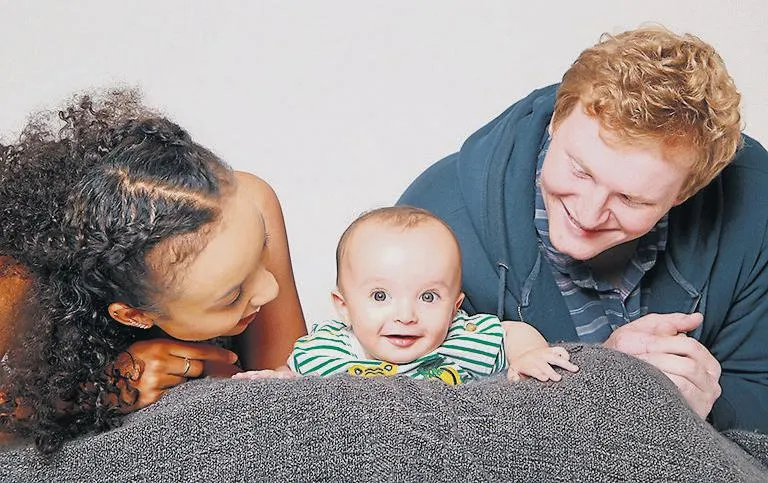
In June, en interviewed a couple based in the US about racism and the church. B is white, and a pastor. His wife T, is black, and works at home.
en: What has been your experience of racism in the past years?
T: Since moving to the US, I haven’t experienced overt, horrible racism. I know I am some people’s ‘token black friend’. There are times where people in my presence would openly say ‘black people are…’ and fill the gap with a grim racial stereotype, and I’m right there next to them!
It’s been different for my brothers though. When one brother was looking for somewhere to live in the US, the estate agent was driving him around and said to him: ‘Don’t live there, it’s a black area.’ And when he was moving, his neighbour said: ‘Don’t sell it to another black person. You’re okay as you’re not loud,’ and so on. So essentially if you don’t fit a person’s stereotype of a black person then you’re okay. You’re not like ‘the rest’. It’s as if it is acceptable to be racist on some level.
B: I grew up in a completely white area of the country. I met no one of a different colour until college. I didn’t see or hear any racism among those I knew as I was growing up.
en: Tell me how the people around you reacted when you planned to marry.
B: There was some prejudice which was couched in terms of what would happen to our children. No outright statements were said about not marrying T, but people asked how our biracial children would be treated. They couched their thinking in those terms.
T: When I first met your aunt, I put my hand out to her and she didn’t offer it back. My dad, knowing what it could be like in the US, asked B if people in the community would accept me when we married.
B: Yes, her dad was concerned about his daughter and I totally understood why he was asking. He was so gentle. His questioning was all about caring for us as a couple.
en: What about in church now? Are you trailblazing as a couple?
B: Most church people treat T well as she’s a pastor’s wife. And we’re seen positively as we can reach the whole community that our church is in. Broadly, biracial couples are viewed as almost taboo. But I am not in need of people’s approval.
T: At times I can sense a moment of hesitation with people, but nothing overt exactly. We’ve had people leave the church, though, after they’ve been known to say: ‘This is going to be an all-black church soon’.
en: What’s the way forward for churches where that kind of attitude is present?
B: A pastor said recently: ‘If your community looks like a pack of Skittles, then your church should’. And our church doesn’t still and it really ought. If you are not wanted, if there is a coldness, you won’t go back. We are dealing with a current problem which has deep historical roots.
T: People need to talk about all of this. Apathy is part of the problem. This country here is rioting and people from a white part of the country we know are still posting pictures of their weekend walks. They are not affected one iota. It is an uncomfortable topic to discuss. One sermon preached recently stating explicitly ‘we should have more black people in this church’, had the two black women in the congregation shout out ‘Amen’.
B: Anyone knows if they are the token friend. Individually and corporately, we need to pray that ‘by your providence Lord, in the sphere in which we live, bring us genuine friendships with people who are different to us in any way’. Start with prayer. We need to give people an ear, too, and listen to their stories and grievances and not dismiss people.
T: Be intentional. Befriend people. Humanise people who don’t look like you to your children, because racism is learned. You need to see colour…
en: …because you need to see experience?
T: Exactly. It helps you know that person in that context, in their experience.
B: There’s unity in diversity and diversity in unity. Don’t beat yourself up if you don’t have people who are black in your community around the church, but if you do have diversity in your community, then it must be reflected in your church.
T: People need to discuss their prejudice. It can be that the way we run ministries is reaching people, but reaching people in a prejudicial way e.g. by keeping people groups dependent upon us.
B: We have to teach Genesis 1: 26-27. We are made in the image of God, and Christ breaks down walls of hostility between one another. There is racial reconciliation in the blood of Christ. We have to have this as a regular part of our teaching culture in the church. Then, the church leaders have to model what we need in our churches. Everything that happens in a church comes from the leaders’ modelling.
en: Is it about addressing hidden and structural prejudice?
B: It’s already been addressed in Christ. We just have to walk it. I need to listen. I don’t know what it’s like to be a black person. There’s a practical application to the theological understanding: we have to change. A church will die and lose its chance to witness if it doesn’t have an ethos that is orientated to Christ and His Kingdom. As Christians we believe the Bible has the answer. We have a fallen nature living in a fallen world. We need to educate people, yes, but the absolute answer is in the blood of Christ.
T: The church can’t have the luxury of being oblivious to all this. If they love the God they can’t see, then they have to love the people they can see.
B: The real issue is people’s hearts.