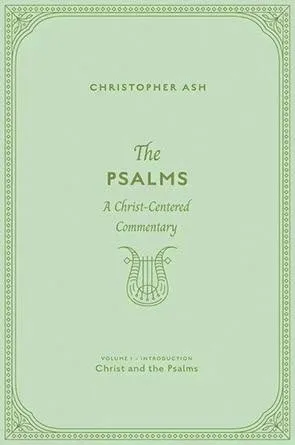
THE PSALMS:
A Christ-Centred Commentary
By Christopher Ash
Crossway. Hardback, four volumes
2480 pages. £117.99
(£77 if you shop around)
ISBN 978 1 433 588 419
It was a privilege to be at Tyndale House in Cambridge on Tuesday 17 September for the launch of Christopher Ash’s much anticipated commentary on the Psalms.
The event was attended by more than 70 people, who heard Ash speak about his magnum opus and field questions. The formal part of the launch was accompanied by a good lunch, an opportunity to meet and greet, and to buy a set of the commentaries.
Reading the commentary there are several things that immediately strike the reader.
It is a vast project; this is a big commentary on a big Biblical book. Volume 1 is an extensive introduction, the other three divide the commentary into three helpings of 50 psalms each.
I often find introductions to commentaries rather dull, but this one by contrast is essential reading. In three main sections, Ash outlines his approach to reading the Psalms, looks at the theological implication of such an approach, and then takes the reader on a whistlestop tour of the history of Psalm interpretation. This volume concludes with four appendices on Psalm superscriptions, quotations and echoes of the Psalms in the New Testament, and notes on authors quoted.
This volume is like the Highway Code for reading the Psalms; vital reading before stepping into the car to navigate 150 car rides and avoid any exegetical car crashes! This volume is the manual that needs to be mastered before approaching the rest of the commentary.
It is a thorough project. Ash has left no stone unturned and no key text on the Psalms unread. Ash is a careful scholar who takes pains to reach a conclusion and helpfully lays out his reasons for the interpretative choices he makes. I spent a week at Tyndale House in January 2022, while there I took a peep at Christopher Ash’s research desk (Ash is a Scholar in Residence at Tyndale House). The desk was laden with a vast array of the best books on the Psalms which were, as Ash calls them, ‘friends’ called in to assist him with his reflection on each of the 150 Psalms.
This is not a technical commentary, but it is a rigorous one that will be useful for preachers and anyone wanting to read the Bible with greater understanding.
The structure of each commentary is simple and comes in four sections:
1. Quotations from previous interpreters (mainly vintage!)
2. Orientation: where the trajectory of the interpretation is laid out. This gives particular attention to the way that this reflects the voice of Christ, giving attention to quotations and allusions in the New Testament and the analogy of faith.
3. Text: a verse-by-verse commentary.
4. Reflection and response.
It is a project with an agenda. Ash lays his cards on the table near the beginning of the introductory volume: ‘Like an adventurer planting a flag in occupied territory, I want to reclaim the Psalms for Christ.’
Ash is careful to explain what he is not doing: ‘In arguing for a Christ-centred reading, I have occasionally been misheard as if I were suggesting that individual Christians cannot pray the Psalms. Far from it!’
Ash builds on Bonhoeffer’s Prayer Book of the Bible, who argues, in line with most Biblical commentaries written in the pre-modern periods of church history, that the Psalms are the prayer book of Christ. By contrast many recent commentaries on Psalms focus on the original setting of the Psalm, and have little in the way of reflection on how they fit into the whole Biblical story. Ash attempts to read all 150 Psalms through the eyes of Christ, hearing the voice of Christ.
Ash reads each Psalm in the historical context, filtered through the experience of the writer. Ash then seeks to read every Psalm as a song that finds its fulfilment in Christ but also one that has been inspired by the Spirit as an expression of the eternal Word. Ash then seeks to retrieve each Psalm for the believer by praying the Psalm in Christ.
Readers will have to be the judge of how successful Ash has been at doing this with every Psalm. Some preachers might feel that at times Ash overdoes this and will need to make their own decisions about how high in the mix Christ should be in preaching on a particular Psalm. True Christ-centred preaching does not adopt a ‘where’s Wally’ approach to finding Christ in the Old Testament; we do not try to smuggle Him in, we simply try to let him out!
This commentary represents a labour of love. Ash clearly loves the Psalms and the Lord who reveals himself there. Ash says that he probably quotes Augustine more than any other author. At one point he quotes Augustine, but could almost be talking about himself: ‘I nourish you with what nourishes me; I offer to you what I live on myself.’
Ash speaks of three aspects of joining the Psalms: cognitive, affectional and volitional. I guess that Ash will feel that his job is done if he gets his readers to grasp these three steps:
1. Think carefully about how to read the Psalms with a view to tracing the voice of Christ in them.
2. Develop a ‘feel’ for the Psalms, to be in tune with their mood music and experience their distinctive tone and power.
3. Be drawn into a commitment to walk in the path of joyful and peaceful faithfulness even when darkness threatens to snatch away that joy and peace.
Thank you, Christopher, for living in the Psalms and letting the Psalms live in you.