Smartphone threats

John Woods  |  Reviews
Date posted:  1 May 2024
Share Add       
Smartphone threats

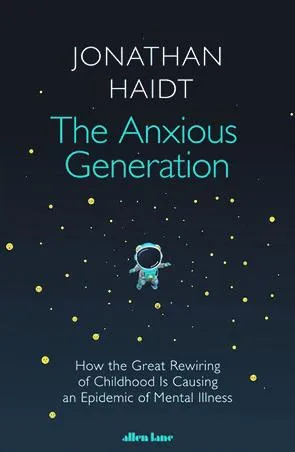
THE ANXIOUS GENERATION:
How the Great Rewiring of Childhood
is Causing an Epidemic of Mental
Illness
By Jonathan Haidt
Allen Lane. 385 pages. £25
ISBN 978 0 241 64766 0

There is nothing new about the idea that our smartphones are doing something to our brains or that they have begun to shape the way we look at life. This new book by Jonathan Haidt, an academic and social commentator, who is best known for his bracing volumes The Righteous Mind and The Coddling of the American Mind, explores this ground with particular attention to Generation Z.

Haidt’s description of Generation Z as ‘the anxious generation’ is based on rigorous research into this age group, who were the first generation to grow up in a smartphone world.

He says: ‘My central claim in this book is that these two trends – overprotection in the real world and underprotection in the virtual world – are the major reasons why children born after 1995 became the anxious generation.’

I have heard Haidt being interviewed about this topic, where he says that he had assumed that this spike in anxiety in this age group was largely a result of the pandemic. When he did the research for this book, he was drawn to the conclusion that the causes go further back.

The author argues that smartphone use has rewired the brains of Generation Z so that they are more prone to anxiety. The smartphone world makes room for the growth of social media, with its ‘like’ and ‘share’ buttons that feed the human search for approval or wounds those who never quite make the grade. This trend was accelerated by the development in 2010 of front-facing cameras that made it easy to takes selfies to post online.

Haidt suggests that the use of smartphones at a younger age has contributed to the replacement of a play-based childhood – with human interaction, managed risk, and a sense of discovery – to an online world where children are together alone and subject to a variety of harms. Haidt describes the four foundational harms of smartphone use: social deprivation, sleep deprivation, attention deprivation and addiction.

In the book he shares the anecdote concerning his six-year-old daughter, who was playing a video game on his iPad. She called out: ‘Daddy, can you take the iPad away from me. I am trying to take my eyes off it, but I can’t.’

Haidt explores the ways that boys and girls experience smartphone use differently. He suggests that the harmful impact of smartphone use is greater on girls because of the way that it shapes the way that girls think about and share their image. Boys by contrast suffer from what Haidt describes as a ‘failure to launch’ into responsible adulthood, aided by escapism from the real world afforded by video games and pornography, both of which can have hugely negative impacts on attitudes to women and violence.

This is not an overtly Christian book, but it does contain a chapter entitled ‘Spiritual Elevation and Degradation’. Haidt argues that smartphone use can lead to spiritual degradation that needs to be elevated by the adoption of the following spiritual practices:

1. Shared sacredness; 2. Embodiment; 3. Stillness, silence, and focus; 4. Transcending the self; 5. Be slow to anger and quick to forgive; 6. Find awe in nature.

Haidt suggests that smartphones can be used to try to fill what Blaise Pascal called ‘the God-shaped-hole’ in our lives.

‘In a phone-based life, we are exposed to an extraordinary amount of content, much of it chosen by algorithms and pushed to us via notifications that interrupt whatever we are doing. It’s too much, and a lot of it pulls us downwards on the divinity dimension … We need to take back control of our lives.’

The book concludes with a variety of practical proposals for governments, tech companies, schools and parents to take action.

The digital revolution has sucked us into a virtual world without a map and/or a compass. The result is a disorientated and anxious generation. Haidt writes that this book is ‘… about how to reclaim human life for human beings in all generations.’

We would all do well to heed the call and consider a radical reset in our attitude to smartphone use, especially for those in their formative years. 

Share
< Previous article| Reviews| Next article >
Read more articles on:   social media
Read more articles by John Woods >>
Reviews
Rest refocussed through Christ

Rest refocussed through Christ

It is always a treat to receive one of these silver-covered volumes in the “New Studies in Biblical Theology” series. …

Reviews
Friendly church? Love more and more!

Friendly church? Love more and more!

BECOMING A FRIENDLIER CHURCH: A Pathway to Genuine CommunityBy Matthew D. KimBaker Books. 167 pages. £16.99ISBN 978 …

Looking for a job?

Browse all our current job adverts

Search

About en

Our vision, values and history

Read more