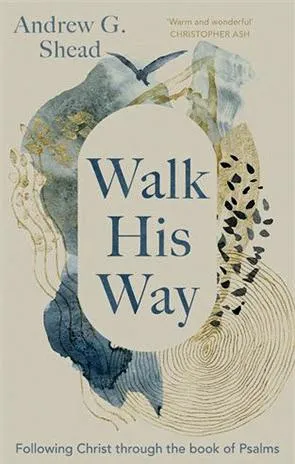
WALK HIS WAY:
Following Christ through the book of
Psalms
By Andrew G. Shead
IVP. 142 pages. £11.99
ISBN 978 1 788 744 781
Sometimes a book lands on my desk that I think I must read, but life and other books push it down my list of priorities.
Maybe you have had a similar experience after a conference from which you returned with a bulging bag of recommended must-have books by the platform speakers. Then a little while later you pick up the book and wonder why it has taken you so long! This book falls into that category.
Andrew Shead’s book on selected Psalms began its life as a series of summer school lectures delivered in New South Wales. The author has sought to retain the immediacy of the original talks, which gives them a directness that is personal and intimate. But why invest 12 quid in a book that looks at eight psalms? Here are eight reasons.
1. The psalms that are chosen, 1, 2, 32, 69, 88, 91, 118 and 147 provide a good introduction to the content and message of the five books that make up the Psalter. Shead sets the individual psalms in this context, which helps readers to know where they are on the journey through this massive 150-part book, which the author likens to ‘a library spread across five interconnected books’.
2. This book gives a good overview of the archaeology of the whole Psalter and the structure of each of the eight psalms treated here. Tracing the arc from the first two psalms to the climax in the final five Hallelujah Psalms we see the moods and movement of this wide-ranging Biblical book. The author speaks of the Psalter as a river of song and these eight psalms as stopping places where we can map out the river’s path.
3. These studies never forget the original settings of these psalms or the experience of the authors and the context of the initial hearers.
4. As the sub-title suggests, these studies help the reader to follow Christ through the book of Psalms. Shead provides some beautiful explorations of these psalms as the hymn sheet of Jesus and the thought world that He inhabited
5. This Christological focus does not take place at the expense of treating the psalms as prayers that can be prayed by contemporary believers. The author helpfully traces the Christological interpretation of each of the psalms he examines, but he also helps the reader see the multi-layered voices of the psalmist, the individual believer, and in the case of Psalm 69, Jeremiah the prophet. This richly textured approach helps to prevent an interpretation that only concentrates on the original historical context of the psalm, the individual believer praying the psalm, or on its Christological fulfilment. This useful trifocal reading provides a number of potential pathways of reflection for readers or preachers of the psalms.
6. In treating Psalms 69, 88, and 91 the author provides help with some of the more challenging psalms in the Psalter. Indeed, his treatment of Psalm 88, the only lament in the Psalter that provides no relief from the darkness, is a masterclass in Biblical exposition.
7. These studies are intellectually satisfying, spiritually nourishing, and immensely practical.
8. Daniel Shead writes in an engaging manner. This slim but substantial book left me wanting more. This would be a great book to use for a week or so reading one of the Psalms a day.