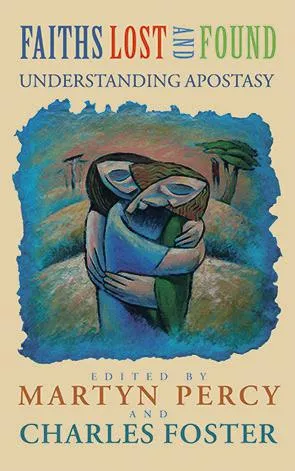
FAITHS LOST AND FOUND:
Understanding Apostacy
Edited by Martyn Percy and Charles
Foster
Darton Longman & Todd. 172 pages.
£16.99
ISBN 978 1 915 412 324
This is an unusual book, that may not immediately appeal to every en reader. Nevertheless, I am glad that I have read it, because it addresses vital issues.
To be clear, when the editors talk about understanding apostacy they are not providing an exhaustive theological definition. This is more of a sociology of religion book, telling the stories of ten people who have moved away from their original spiritual moorings. Most of these stories describe a drift away from a traditional evangelical position toward a much broader theological perspective; one story is written by a Jew, and one story relates the move from Catholicism to Evangelicalism.
The latter story is about Richard Baxter (not that one from the 17th century; he gets that all the time!) This highlights one of the problems with the use of the word apostacy. I expect that all en readers would see this move as a glorious conversion rather than an apostacy.
I am grateful to Richard for being willing to have a brief chat on Zoom to discuss his contribution, which emerged out of one of the editors hearing his testimony online and them asking him to turn it into a chapter.
Gripped by the gospel
I liked the tone of the chapter, which included gratitude for the kindness displayed to him by his local Roman Catholic leaders, but also a clear point of departure as the full implications of the gospel gripped him. Richard Baxter, whose role at Carey Baptist in Reading is Pastor of Outreach, did speak about how evangelicals are capable of alienating newcomers by their words and actions. Leaders and churches can appear more demanding than God Himself, sterner than His commands, and liable to be fixated on minor issues that tend to deter rather than attract.
Some of the stories in this book make for very painful reading, not least the two that reference Iwerne Camps, one of which is titled ‘Iwerne to Yoga’! These stories are not entirely negative, but they do show how some people perceive the emphasis of conservative evangelical groups. Evangelical church leaders can read and learn from these ‘exit polls’ something of the complicated dynamics of those who have been part of our ranks, sometimes in prominent positions, but have decided to jump ship.
Things to learn?
It is possible to read many of these stories and conclude they were going to leave anyway, so nothing that the leaders of their first spiritual tribe could have done would have made a difference. Whilst this might have a grain of truth in it, it does miss the point. Could there be something to learn from these exit interviews that might provide clues on how to avoid the inevitability of certain types of people walking out the door and never coming back?