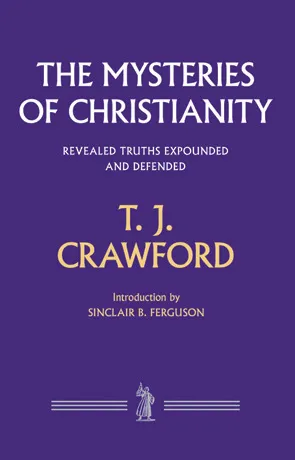
THE MYSTERIES OF CHRISTIANITY:
Revealed Truths Expounded and Defended
By T.J. Crawford
Banner of Truth. 239 pages. £15.50
ISBN 978 1 848 717 152
The aim of this book is to explain and defend Christianity as ‘a supernatural Trinitarian faith at the heart of which lie the mysteries of the incarnation, the atonement, the sovereign work of the Holy Spirit and the marvels of divine providence’.
The Mysteries of Christianity is the transcript of the Baird Lectures delivered by Thomas Jackson Crawford (1812–1875) in Glasgow University in 1874. The Lectures were set up to promote ‘vigorous Christian testimony’. He argues that the supernatural realities of Christianity can only be know if God chooses to reveal them and that even after they have been revealed their very nature will mean that they are beyond full comprehension.
The first five of the 12 lectures deal with the nature and place of mystery in the Christian faith. Crawford acknowledges the transcendence of the subject, the limits of human language and the intellectual effects of sin. This is an exhaustive and unique treatment of an important subject, which repays careful study. The author shows that in spite of the limits of human knowledge we can still have confidence about Christian dogmas.
The secret influence of the Spirit
The next six lectures deal with specific doctrines which are at the heart of the faith. I particularly enjoyed the chapter on the work of the Spirit, which emphasises the secret but potent influence of the Spirit on the human heart. There are also two helpful chapters on the mystery of providence. If there is anything missing in this section it is a treatment of the mystery of the inspiration and nature of Scripture. A final lecture calls for humility in the face of the mysteries of the faith.
This is probably not a book for the general reader. Crawford’s engagement with the theological currents of his day makes it somewhat dated. He often uses proof-texting rather than giving the detailed exposition of specific passages.
Anticipating criticisms
However, the book repays study. Crawford’s approach involves a careful statement and an exhaustive defence of doctrines which are vital to the health of the Christian faith. He was a man with a very agile mind who anticipates many of the criticisms which have been levelled at the supernatural foundations of Christianity.
It is perhaps not the first place one might turn to for the exposition or defence of these doctrines. However, armed with a good grasp of these truths, Crawford is helpful in pushing the reader to think through some of the ramifications of the subject.