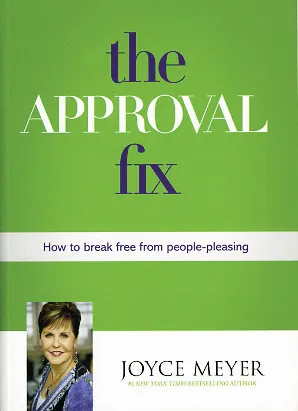
THE APPROVAL FIX
How to break free from people pleasing
By Joyce Meyer,
Hodder & Stoughton. 139 pages. £8.99
ISBN 978 1 444 785 6654
YOU CAN BEGIN AGAIN
By Joyce Meyer
Hodder & Stoughton. 197 pages. £13.99
ISBN 978 1 444 785 364
She is the director of a multi-million dollar ministry, she preaches at packed-out stadium tours, she is a #1 New York Times best-selling author, she came in at 17 on Time Magazine’s list of the 25 most influential evangelicals in America, ahead of J I Packer, she influences millions through TV broadcasts and the sale of her books and this influence is not just in America, but spreads into Europe too.
She is coming to London next spring. Her popularity may be linked to her personal story that shows she is a survivor who has come through hardship, or maybe it is her no-nonsense presentation, or perhaps it is the attractiveness of her message to hurting people. I confess that when I came to review her latest books I approached them with scepticism, not least because of my concern about her multi-million dollar lifestyle. So I tried hard to read these books with the following question in my mind – if I picked these up at a local bookstore and knew nothing of Joyce Meyer, would they help me to follow Jesus?
Addicted to Jesus
Joyce’s prayer for her readers is that they discover God for themselves through her writing. In The Approval Fix she writes: ‘I want you to become addicted to Jesus and to the Word of God’. In You Can Begin Again she is clear that: ‘deep and abiding relationship with God is the foundation and source of every new beginning’. In both books she talks of Christ’s death, the offer of new life, gospel transformation and the need to submit to the word of God.
Just when I concluded she never mentioned sin, only talking of mistakes and failures, she mentioned sin. When I thought she only promised success, she qualified it by saying that we will not always have mountain-top experiences and at times God disciplines us. The gospel she describes is positive and affirming, she points to grace in Christ and the encouragement of God’s love. She declares the transforming power of God to change our lives: ‘turn the construction of your life over to God – he’ll build something beautiful’. The problem is that, despite everything she says about wanting us to develop a relationship with God, ultimately what her gospel promises is psychological health, greater confidence, deeper emotional stability and recovery from past hurts and failure. It is not a gospel that looks forward to the day when Christ is seen to be head of all things and his kingdom is established. Instead, it is rooted in the here and now. Her teaching is ultimately prosperity theology combined with popular self-esteem psychology.
Despite putting in a few caveats here and there, she suggests that if you get right with God you will achieve success now in whatever sphere you put your mind to: You Can Begin Again is littered with illustrations of personal achievements, from Joyce’s own life to individuals who got Olympic gold medals, Hollywood careers, or an international fast food chain. Both books follow this formula: God loves you, get right with him and you will be happy. Of course on one level this is true, but it misses out entirely the call to take up our cross and follow Christ; there is no cost, no sacrifice.
Man-centred hermeneutics
Her books are full of biblical quotations and illustrations from the lives of biblical characters: for example she uses Ruth as someone who chose to break free and not be a victim. Her hermeneutics are man-centred and not God-centred. She completely fails to appreciate Ruth’s commitment to God and her place in God’s plan of salvation. Each character that she studies, from Moses to David, is dealt with in the same way: they are used as examples of moving from failure and weakness to success rather than seeing what God was doing in the history of salvation. She fails to see Christ in the pages of Scripture. Instead it becomes a manual for self-improvement.
Does it matter whether women in our churches read this sort of material? Does it do harm? Yes, it does. John Piper once said that ‘wimpy theology makes wimpy women’ and it is true. This teaching will not build strong foundations for the women in our church families. Not only that but it will lead some astray with its false promises and wrong perspective. It encourages self-cen-tredness, not Christ-centredness. Joyce writes that we should partner with Christ to pursue our goals but the problem is that she encourages us to pursue our goals.
Sadly I concluded that the gospel of Joyce Meyer may be one that our itchy ears like to hear, but it is not the one that the NT proclaims. These books are seductively dressed in gospel language but they do not point us to Christ or help us walk closer with him. This gospel has no place for discipleship that involves suffering and endurance. I don’t think Christians in Iraq or North Korea would find her message very credible.
From bird migration to Biblical mission
March is the month when flocks of overwintering birds begin to leave the UK. Bird migration is an incredible natural …