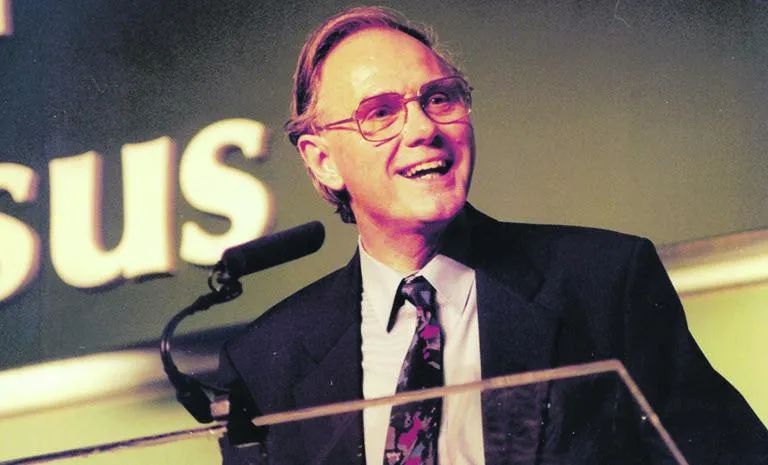
From the Keswick Convention to Word Alive to local church ministry and beyond – it is hard to overestimate the scope and significance of Philip Hacking’s ministry. He died on 6 December with 93 years of life and nearly as many years of gospel ministry behind him.
Philip was born in 1931 into a working-class family and grew up on the terraced streets of Blackburn, Lancashire. He attended the Church of the Saviour, a fairly new Anglican parish. It had a significant impact not just on his life but his ministry with the patterns that were laid down there. Philip wrote: ‘Prayer and Bible study and expository preaching were the order of the day, and I discovered the joy of seeing the treasures of the Bible unfolded’. They would remain the ‘order of the day’ throughout his ministry. He remembered too how ‘as teenagers we were encouraged to lead our own youth groups and to be involved in Christian witness’. Strikingly, at the same time as Philip, three others from the row of terraced houses in which he lived were called into ordained ministry.
Philip read History at Oxford, the first in his family to go to university. But it was at the Keswick Convention in 1952 that Philip stood with his fiancée Margaret to commit themselves to serving God wherever and however He might use them. Nurtured by St Ebbe’s and the OICCU and trained at Oak Hill he was both ordained and married in 1955 and served as a curate in St Helens, Lancashire where their daughter Catherine was born in 1957. Stuart, their son, arrived in 1960 by which time the family had moved north of the border as Philip had become rector of St Thomas’ Edinburgh the year before, the youngest rector in Scotland at the time. They came south again, at least as far as Sheffield where Philip was vicar of Christ Church Fulwood from 1968–1997.
Of course the bare facts of his ministry history only tell half the story. What was remarkable about Philip was both the breadth and depth of his ministry. An ordained Anglican minister all his working life, he had the Church of England in his bloodstream, but there was nothing narrow about his loyalties or affections. Alongside his rich parish ministry, he spoke at countless university and parish missions as well as conventions and conferences across the world. The Keswick Convention played an important role in his life and ministry, but he also played a significant part in its history. His courage and energy helped pull it away from an increasingly sepia-tinted appearance. He first preached there in 1963, but chaired the Convention from 1984–1993 and, as one subsequent chairman, John Risbridger, put it: ‘It is hard to overestimate the significance of Philip’s visionary leadership in Keswick which helped transform it into the large, contemporary, family event which it is today’.
His energy was remarkable, for as he laid down his Keswick responsibilities Philip co-founded and chaired Word Alive as it began its life. When he retired he took on being a founding trustee of the Oakes Holiday Centre and served as trustee for ten years. His gospel heart gave him a vision to match that energy. A concern for world mission was always there, including being chair of Sudan United Mission from1970–1982; a concern for the lost saw him organise a citywide mission in Edinburgh and then persuade Billy Graham to speak at Mission Sheffield in 1985. A willingness to contend for the gospel also took him to the chairmanship of Reform (1993–2000) and the awkwardness for him of involvement in church politics, as well as putting him at odds with many in the Church of England hierarchy, not to mention old friends who did not see the dangers to the gospel as acutely as he did. The inclusiveness of the gospel meant that a solidly middle-class parish like Fulwood would be linked in a real partnership with parishes in a former mining village and a Barnsley housing estate. In between all of that he somehow found time to author several books!
It would be foolish to imagine that he left the parish with only a superficial ministry. Philip was unashamedly a parish man. Like most people who have been in ministry for some time, there was a pattern to his ministry. Indeed there was a pattern for nearly all his life. His secretary could tell you not just when and where he and Margaret would take their holiday, but also which service station they would stop at on the way! He was a man of his generation of course, not the most high tech of ministers, but parish ministry focused for him around Sunday, when he would almost always be in the pulpit, and the midweek Bible study and prayer meeting which he would lead, faithfully teaching his way through the Bible week by week. Then again he was also a prodigious visitor around the parish, with a healthy scepticism towards those who had such an emphasis on their Bible study preparation that they lost their love for people. His visits may have been quick ones, but they brought him into the lives of the parishioners who will still talk of Philip visiting when a child was born, a relative died, they had just moved in, and so on. It kept his preaching connected to the lives of the church family and sermons wouldn’t be complete either without some reference to his great sporting passions, cricket (he knew Wisden nearly as well as he knew the Bible!) and football (or at least Sheffield Wednesday). The Bible, the people and prayer were the bedrock of Philip’s ministry. A totally credible rumour stated that he would regularly work his way through the electoral roll as his prayer list, and certainly his ability to know the names of a congregation of 1,000 was beyond impressive.
Above all Philip was a gospel man, with a passion for making the gospel known. One former colleague heard him preach at a funeral when he was 80. He commented afterwards: ‘The passion was still there, the ability to speak into the occasion, the insightful engaging with the passage (Philip was never just a "blessed thought" preacher), and the courage to bring the gospel challenge and not let the opportunity slide by, even though the vast majority were committed Christians.'
Philip died leaving behind Margaret and his two children, five grandchildren, ten great grandchildren, and countless thousands who are grateful to God for his gospel ministry.
Service of thanksgiving
There will be a service of Thanksgiving held at 2pm on Thursday February 20 at Christ Church Fulwood. A warm invitation is extended for all to come and celebrate our partnership of the gospel in the past and present, and in the spirit and call of Matthew 9.36-38 to encourage the next generation of gospel ministers. Please RSVP here.
The service will be followed by fellowship over tea and cake. Donations will go to: Keswick Ministries and The Oakes Family Centre.
Bookstall: The Renewed Pastor: Essays on the Pastoral Ministry (published to honour the occasion of Philip's 80th birthday).