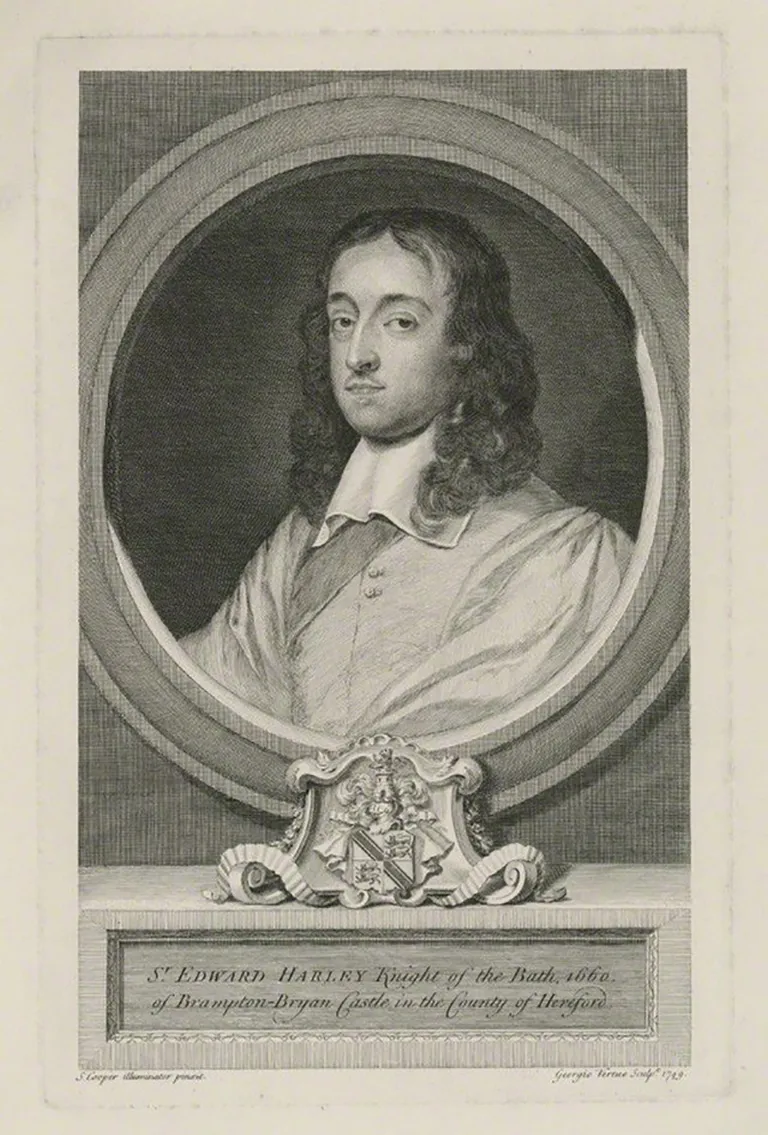
Brilliana Harley (1598-1643) was a prolific letter writer. Close to 400 of her letters written from 1623 until her death in October 1643 have survived. They provide a detailed picture of her married life with husband Robert, the outbreak of the Civil War in Herefordshire, and the life of a family at odds with local political sentiment. The majority of these letters are to her eldest son Edward, or Ned, as she calls him.
Edward Harley (1624 –1700), Brilliana and Robert’s eldest son, went up to Magdalen Hall at Oxford University in 1638, which was to Oxford what Emmanuel College was to Cambridge, namely, a seedbed for Puritanism.
He stayed at Oxford for two years, went down in 1640, and when the Civil War broke out in 1642, he fought with the Parliamentary armies. He supported the Presbyterians, and later opposed Cromwell, and thus fell out of favour with the government of the Commonwealth. He supported the Restoration of Charles II, but also the religious toleration of non-Anglicans, known as Dissenters or Nonconformists.
From 1660 onwards, Edward was a Member of Parliament during the reigns of Charles II and William III. And while he attended the state church, he also went to hear the preaching of Richard Baxter (1615–1691). According to one account of his life, Edward Harley developed ‘a very Christian temper’ and was ‘a good and religious man, untainted by the evils of that most licentious age’. This was owing, this account continued, to God’s grace and his constant reading of the Scriptures. But one also must think of the way God used the influence of his mother’s piety.
Brilliana’s love for Ned
Brilliana’s letters are replete with concern for her son’s physical health, advice regarding his diet and medicine, and notification of gifts of food being sent from Brampton to Oxford. Seamlessly intermingled with such mundane matters are precepts for godly living, nuggets of spiritual advice, and discussion of books the two of them have been reading.
The latter are especially intriguing and reveal Brilliana to have been a voracious reader with a wide variety of literary interests, ranging from theological treatises by celebrated authors like John Calvin and William Perkins to Roman Catholic works, from pamphlets containing the latest news to works of fiction like the fantasy by Francis Godwin (1562– 1633), The Man in the Moone.
In her spiritual advice to her son, a number of items are especially prominent: the importance of regular communion with God in prayer and the private reading of Scripture, ‘the sweet waters of God’s Word’, and other devotional works. Brilliana encouraged him to be earnest in observing the Sabbath, though Edward complained that he could not find a preaching ministry as powerful as that which he had enjoyed at Brampton.
Brilliana’s love for her God
Rooted firmly in God’s word and the Augustinian tradition of Puritanism, the letters of Brilliana reveal a love that was unashamedly affective and experiential. Her use of the word ‘sweet’ and its cognates, for example, provides an excellent window on her conviction in this regard. To open one’s heart in prayer, for God’s elect, is ‘a sweet thing’. Thus, she prayed for her son that he might ‘so … taste that sweetness in God’s service which indeed is in it’. ‘The men of this world cannot perceive it’, she emphasised, for it is one of the choice blessings that accompanies the indwelling of the Spirit. Indeed, she stressed, ‘the service of the Lord is more sweet, more peaceable, more delightful, than the enjoying of all the fading pleasures of the world’.
Should the CofE pay slavery reparations?
During a recent trip to Ghana, Archbishop of Canterbury Sarah Mullally renewed her commitment to a £100 million reparation fund …