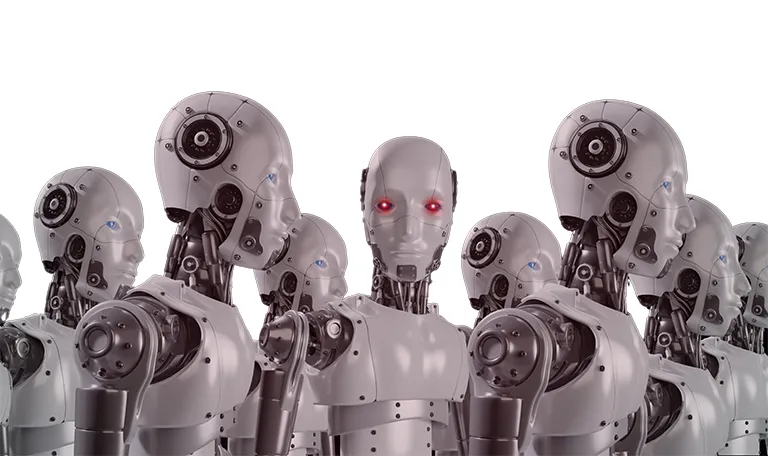
If you’ve seen Mission Impossible: Dead Reckoning, you’ll know the hunt is on for the key to a powerful sentient AI entity – a villainous entity that threatens to unleash god-like omnipotence over the entire world.
It’s a timely movie, illustrating the potential (if fictional) power of artificial intelligence; it’s prescience wasn’t lost on me (I watched it the same night I’d finished the first part of this article).
Paul Ewart, chairman of Christians in Science, comments: ‘There’s a saying: “When science makes a discovery, the devil grabs it while the angels are debating the best way to use it!” There is a lot of concern at present about the dangers of AI. There is also a lot of unnecessary angst, misinformation and misunderstanding.’
For the faint-hearted, the movie may have raised concerns up a notch, but Christians ought to take a less alarmist, more pragmatic approach. ‘Evangelical Christians do not need to worry about existential risk [from AI],’ says David Brenner, founder of AI and Faith.
Consider the potential spiritual and moral consequences of life affected by AI, Ewart advises. ‘The Judaeo-Christian understanding of what it means to be human sees us as integrated body, mind and spirit. The Bible teaches us that how we think, speak and act, especially in relation to others, affects the spiritual development of our character’, he adds.
‘This principle is at the heart of all the Abrahamic faiths. An AI machine does not have a spiritual dimension to its nature, unlike humans who are made in God’s image.’
Ewart urges Christians to ‘speak up for all of us, people of faith or of none, and do all we can to make sure we take moral responsibility for the use of AI to avoid actions that would offend commonly held moral values and, in turn, would have spiritual consequences.’
Brenner reminds Christians that they have an important stewardship role. ‘Accepting the model of Creation, Fall, Redemption and Restoration, it is incumbent on us to seek restoration in all these areas by direct, activist engagement with both governments and businesses.
‘The unusual aspect here is that most of the power is held by Big Tech, not by Big Government. That’s good, because there are many Christians in leadership and creative roles within Big Tech. But it is also complicated by the challenging and hidden, non-transparent nature of this technology and the ability of ordinary people – both good and bad – to engage it.’
We must play defence, urges Brenner, for example, to surveillance; censorship of online engagement based on values hostile to faith; deep fakes; biased and opaque algorithmic decision-making; and generative AI based on training sets that are hostile to religion.
And we must be on the offensive, for instance, with respect to AI-driven medical research and interventions; evangelism and spiritual formation (particularly in hard-to-reach parts of the world through the wonders of Natural Language Processing and the power of Bible translation tools).
Brenner also encourages Christians to lend their voices to regulatory efforts to create boundaries beyond those Big Tech would apply through ordinary risk management. ‘Their risk/reward calculus will very likely be more heavily weighted to reward than the broader interests of society would dictate,’ he points out.
As Ewart says: ‘When deciding how to use AI, let’s choose to be on the side of the angels.’
Is Artificial Intelligence a 'resounding gong'?
Some of my most precious times as a father are when I get to share cultural moments that shaped me, …