This month I want to describe an unusual Christian apologist who has had an enormous influence on Christian thinkers since his time.
Blaise Pascal [see also the article 'Isn't Christianity Restrictive'] (1623–1662) died before the age of 39 and struggled with ill-health all his adult life. Yet, in that time he produced groundbreaking work in geometry, science and philosophy. He has a computer programming language named after him, along with a minor planet and a unit of measurement in science.
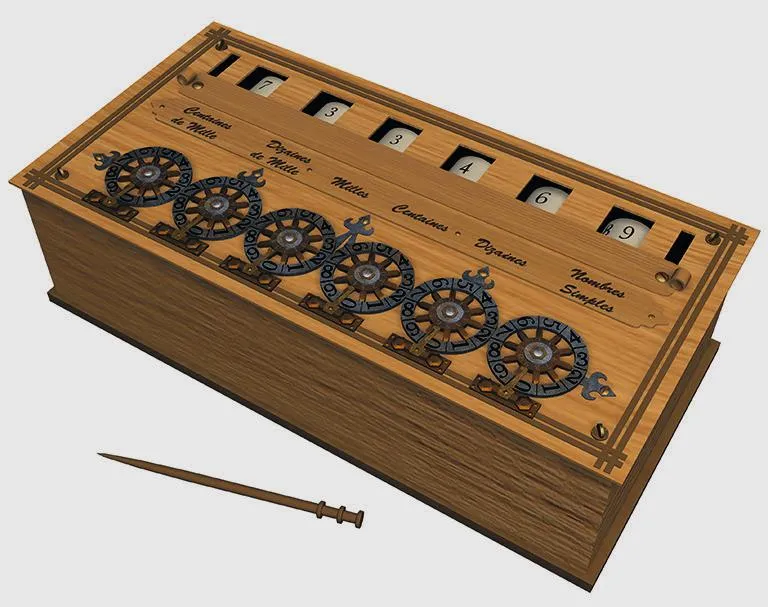
As a teenager he wrote textbooks on geometry and probability theory. In order to help his father with his tax returns he invented the first mechanical calculator. Blaise Pascal is the perfect example of a child prodigy and an adult genius.
Pascal’s Wager
At the age of 31 he had a religious conversion that changed his life. We know a bit about his conversion experience because after he died a servant happened to find a page of his diary sewn inside his jacket. On this page he recounts a mystical encounter beginning: ‘God of Abraham, God of Isaac, God of Jacob, not the God of the Philosophers and of the learned. Certitude. Certitude. Feeling. Joy. Peace. God of Jesus Christ.’ The account of his conversion would remain close to his heart, literally, until he died less than ten years later.
Pascal joined a reforming movement within the Roman Catholic church and applied his mind to matters of faith and belief. He began work on what would have been a formidable book on apologetics, though he died before it was complete. However, the unfinished notes were assembled into a collection called Pensées (Thoughts) which have remained in print ever since.
As a philosopher who had come to experience God in a personal encounter, Pascal believed that faith required more than logic or reasons. In fact, mathematical certainty is not possible in matters of faith. Faith involves a personal commitment to God which goes beyond mere reason. Pascal addresses this with a famous argument we now know as Pascal’s Wager. In essence, Pascal argued that on the basis of probability it is still rational to believe in God even in the absence of absolute certainty. A-Level textbooks up and down the country still discuss Pascal’s Wager to this day.
More than machines
Pascal understood that we are more than just rational machines. He wrote: ‘The heart has its reasons, which reason does not know.’ That’s a brilliant perception of the role of imagination and feeling. It leads to this wise description of how we should evangelise in a sceptical culture: ‘Men despise religion. They hate it and are afraid it may be true. The cure for this is first to show that religion is not contrary to reason but worthy of reverence and respect. Next to make it attractive, make good men wish it were true, and then show that it is.’ It’s timely advice. Sometimes the best evidence and logical arguments fall on deaf ears because our friends don’t want it to be true. We need to find other ways to ‘demolish strongholds’ that predispose our friends against the Christian faith. The beauty of religion, the appeal of moral goodness, the creativity of faith can make people want Christianity to be true.
Pascal’s ideas in his Pensées are thoughtprovoking and intriguing. As it was never properly completed as a book the thoughts can seem erratic. If you want to read it and find it a struggle then I would recommend just leaving a copy on a desk and dipping into it at random from time to time. You never know what gem you will turn up. And you can be sure that Pascal will remain relevant for a long time to come. One of today’s most popular children’s video games, Animal Crossing, even has an otter named after him. Not many apologists have had such a legacy.
Chris Sinkinson is a Lecturer in Theology at Moorlands College.
The Jewishness of the Gospels proves they're true
When speaking to Jewish and Gentile friends you might have heard the accusation that the Gospel accounts were written centuries …