Christians are ‘atheists’?!

Michael Haykin  |  Features  |  history
Date posted:  1 May 2023
Share Add       
Christians are ‘atheists’?!

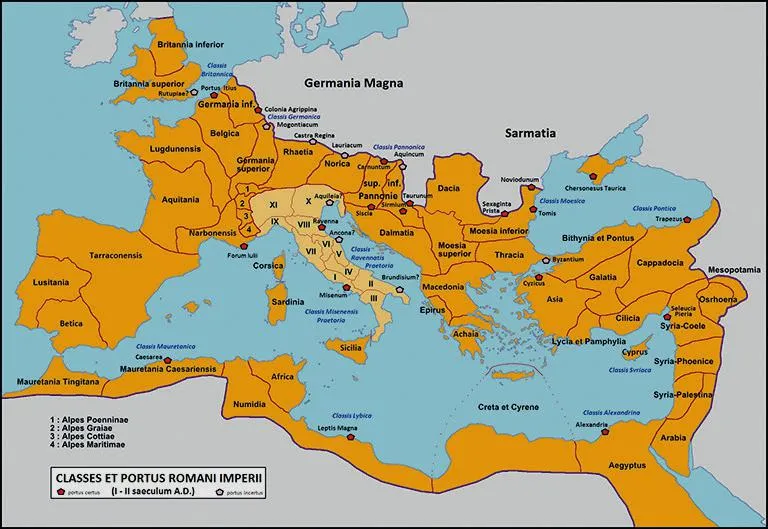
The Roman Empire at its height | photo: Wikimedia

In the minds of some Roman authors, like the first-century BC imperial poet Virgil, Roman rule of the Mediterranean was a gift of the gods to the Roman people.

Early Christians, though, saw it through the eyes of the Biblical understanding of history: it was the Sovereign Lord of history, the God who had revealed Himself definitively in Jesus Christ, who had ultimately caused the political dominance of Rome to take place. And he had done so through a variety of what we call secondary causes.

Levelling up

First, there was the openness of Roman society to upward social mobility from the lower classes and even from the ranks of slaves.

By the end of the second century BC it was a fact there were no formal barriers in the way of any Roman citizen achieving the highest offices of the state. We thus have an example or two of a man who began life as a slave and ended as a Roman governor.

This was quite different from the Greek experience. And to the astonishment of Greek observers, Roman slaves when freed became Roman citizens. This fact sets Rome apart from most other ancient empires and helps to explain the nature of Roman imperialism. Most ancient empires simply demanded tribute from their subjects. Rome demanded only men. Thus it would happen that in a relatively short time after the Romans had conquered a new territory they gave the people of that conquered area Roman citizenship and this, in turn, fuelled the Romanisation of that territory.

Religious innovation

A second key reason for the growth of the Empire was Rome’s policy to transfer the religious cults of defeated communities to Rome. There developed in the Republic a deep willingness to innovate in the sphere of religion.

When the Romans conquered a people, they took that people’s gods and gave their own in return to those they had conquered. On one level, this policy grew out of a superstitious conviction that the more gods you worshipped the better and the more likely you would be successful.

On another level, this religious syncretism was an astute way of Romanising the people conquered, for religion is ever the bearer of culture. As the early Christian author, the Apostle Paul, wrote in 1 Corinthians 8, he and his fellow Christian lived in a world of ‘many gods and many lords’. In other words, from a religious perspective the Romans were committed to pluralism and this had fuelled the growth of their empire.

Clash with monotheism

Little wonder that the Romans, committed to polytheism for both religious and political reasons, were deeply frustrated with the aggressive monotheism of the early Christians. Christian refusal to worship the gods or the emperor led to the charge that Christians were ‘atheists’ and guilty of ‘hatred of the human race’, as the Roman historian Tacitus once put it, which in turn was the prompt for brutal persecution and repression.

Share
< Previous article| Features| Next article >
Read more articles on:   history
Read more articles by Michael Haykin >>
Features
The sword and doctrine:  Killing in the name of God?

The sword and doctrine: Killing in the name of God?

The acceptance by Constantine the Great in 313 of Christianity as a legal religion within the Roman Imperium was a …

Reviews
Raising an Ebenezer!

Raising an Ebenezer!

What a delight it was to come across this board book in a Christian bookstore, Reformed Book Services in Brantford, …

Need to advertise?

We can help you reach Christians across the country

Find out more

Looking for a job?

Browse all our current job adverts

Search