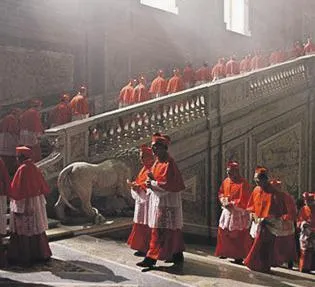
There is a general perception that Pope Francis’s pontificate has entered an irreversibly declining phase.
It is not just a question of age: yes, Pope Francis is elderly and in poor health. But aging aside, the pontificate finds itself navigating a descending parabola. It started with the language of ‘mission’ and ‘reform’. Francis’ reign, now nearly ten years old, was immediately engulfed in difficulties, particularly within the Catholic Church.
Given the predictable end of a season, the question is therefore legitimate: after Francis, who will be the next pope? This question is asked not by some bitter secularist or even a seasoned bookmaker, but by the devout Roman Catholic scholar George Weigel, former biographer of John Paul II (Witness to Hope. The Biography of John Paul II, 1999) and author, among other things, of a book in which he proposes a change in the meaning of the term ‘evangelical’: from being a descriptor of the Protestant faith grounded on Scripture Alone and Faith Alone to an adjective describing a fully-orbed Roman Catholicism (Evangelical Catholicism. Deep Reform in the 21st Century Church, 2013).
In his book The Next Pope. The Office of Peter and a Church in Mission (San Francisco, CA: Ignatius Press, 2020) Weigel draws a composite sketch of the new pope. As Weigel admits (but it doesn’t take much acumen to recognise it), ‘there are profound divisions over Catholic doctrine and identity, praxis and mission, within the Church itself’ (p.9). For the American scholar, the next pope will need to embody a militant Roman Catholicism: faithful to its traditional doctrine, integral in its moral teaching, consistent in its ecclesial practices, made up of devout Catholics. For Weigel, the new pope ‘will have to devote himself fully to the new evangelisation as the great strategy of the Church of the 21st century’ (p.23).
In order to ‘evangelise’, the Roman Catholic Church must, according to Weigel, regain its identity as a sacramental and hierarchical church, combining this with its consolidated cluster of doctrines and practices handed down by tradition, i.e. the ‘fullness of the Catholic faith’. Weigel warns Roman Catholicism against going down the bankrupt path of liberal Protestantism which, by way of adapting to modern times, has lost its convictions and has also seen its churches empty. From his North American point of view, Weigel says that ‘the growing branches of Protestantism in the world are evangelicals, Pentecostals or fundamentalists’ (p.56), all characterised by ‘clear teaching and firm moral expectations’. For Weigel, ‘light Catholicism will lead to zero Catholicism’ (p.59), the loss of faith, and a dissolutive process.
Weigel often uses a kind of ‘evangelical’ language to describe the pope of his dreams. He speaks of fervour of spirit and solidity of convictions, all indicators not so much of doctrinal contents, but of the experiences of the evangelical faith. At the same time he speaks a very Roman Catholic language: he refers to salvation through baptism, Roman hierarchy, papal primacy, and Marian devotions. As a traditionalist Catholic, Weigel believes that everything Roman Catholicism has collected thougout history (e.g. the Council of Trent, Vatican I, Marian dogmas, etc.) should be kept and nothing lost. All of this is very Catholic. He wants to make people believe that Roman Catholicism can (indeed must) also be ‘evangelical’ without losing its Catholic tenets. He has in mind a pope who is very traditional in doctrine (anti-evangelical), yet very passionate and committed like an ‘evangelical’. This is the kind of pope he hopes for.
Whoever is elected, the next pope is unlikely to be an ‘evangelical’ if the word ‘evangelical’ retains its doctrinal and historical meaning. The ‘evangel’ is not the paramount commitment of the Roman Catholic Church. Therefore, its head will never be an ‘evangelical’ pope if the Roman Church will not undergo a reformation according to the ‘evangel’.