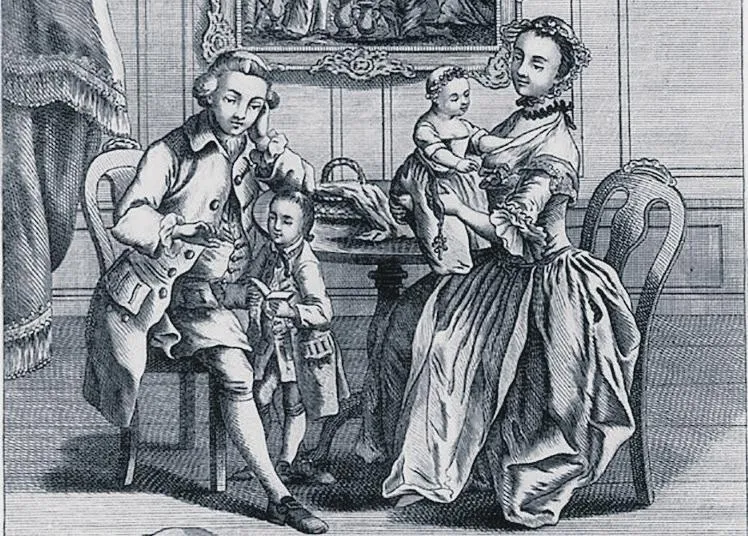
Over the past two centuries, there has been a steady recession of the social role of fatherhood. Fathers have either gradually moved or been moved from the heart to the margins of family life.
Overall, the cultural story of fatherhood in the West has been essentially downhill since the Industrial Revolution of the late 18th and 19th centuries. But at the outset of the 18th century, fathers were regarded as primary and irreplaceable caregivers in the family.
Five aspects of 18-century father-hood
The central role that fathers played in the nurture and flourishing of their children can be seen in five distinct ways:
1. Throughout the 18th century, child-rearing manuals were generally addressed to fathers, not to mothers.
2. Until the early 19th century, when there was a divorce it was the established custom to award the custody of children to their fathers.
3. Throughout this period, it was fathers, not mothers, who were the chief correspondents with any children who lived away from home.
4. Fathers were regarded as the primary influencers of the marital choices of their children and were responsible for the entry of children, especially sons, into the world outside the home.
5. And most importantly, fathers had the primary responsibility for what was seen as the most essential of parental tasks: the religious and moral education of the children. As a result – rightly or wrongly – it would be the father who was praised or blamed for the eventual outcome of a child’s life.
Fatherhood contracting
Running an eye over this list, it is easy to see that there has been a fundamental contraction of the concept of fatherhood in the past 300 years. Industrialisation and the emergence of the modern economy led to the physical separation of home and work.
No longer, as the neo-Freudian thinker Alexander Mitscherlich (1908–1982) once put it, could children typically acquire skills ‘by watching one’s father, working with him, seeing the way he handled things, observing the degree of knowledge and skill he had attained as well as his limitations’. This absence of the father for much of the day led to a steady feminisation of the domestic sphere.
Accompanying this radical change were a fistful of new ideas about the nature of gender and family life. Childhood, for example, came to be seen as a special stage of life that women were designed to supervise. Their nurturing capabilities were seen in distinct contrast to the outside world that was the sphere of men. As early as the 1830s, child-rearing manuals, now more often addressed to mothers, began to deplore the father’s absence from the home.
Of course, this contraction of the paternal sphere did not impact the Western world uniformly, yet the overall trend of the 19th century is clearly toward the shrinking of fatherhood. ‘Paternal neglect’, warned a New England pastor in 1842, was causing ‘the ruin of many families’.
Twentieth-century fatherhood
By the 20th century, many men were looking outside the home for the meaning of their maleness. In the words of David Blankenhorn, ‘masculinity became less domesticated, defined less by effective paternity and more by individual ambition and achievement’. The fatherhood of men was reduced to one role: that of breadwinner. And this was challenged by the increasing number of women entering the workforce after World War II.
An 18th-century father would not recognise his counterpart in the 21st-century West. One great need of the present day is to retrieve what fatherhood truly means.
Should the CofE pay slavery reparations?
During a recent trip to Ghana, Archbishop of Canterbury Sarah Mullally renewed her commitment to a £100 million reparation fund …