I have been hearing murmurs about this book for a long time. It is a debut novel that has taken the publishing world by surprise, and continues to be on the bestseller lists two years after hitting the shelves.
I’ve been intrigued as to why so many people are recommending it, and why it has such a broad appeal. A book with a far reach like this raises the question of what message is being conveyed by the author that so many people from all different walks of life want to hear. As a Christian, it’s an interesting question to consider as we explore our own world view in relation to those around us. Maybe there’s a hint in this novel as to how the world around us is thinking.
The opening chapter sets up the premise that pushes the narrative along to its surprising ending. A local man has been found dead, seemingly having fallen off the fire tower near a small coastal town in North Carolina. It is deemed to be suspicious, and so the town’s sheriff is looking for a perpetrator.
While this murder mystery hooks the reader initially, and gathers pace and tension as we hit the courtroom later in the book, the richness, depth and heart of this novel lies with the main protagonist – Kya –and the marshland which she inhabits and which she loves. We are introduced to the ‘marsh girl’ when she is just six years old, and our first sight is of her watching her ‘ma’ walk away from the family home and never come back. She is left with her four siblings and her drunken, violent father. Within a few pages, all of her siblings have drifted away and it is only her father left, who is sporadic in his presence and sobriety.
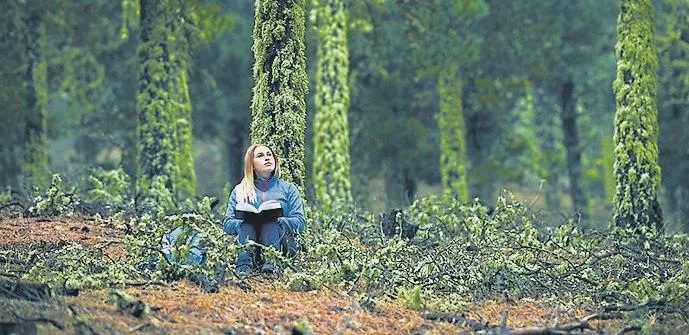
Kya’s isolation, and consequent loneliness, is a dominant thread throughout the novel. She finds solace in the company of the animals and birds that inhabit the marshland, and it’s through her perceptive eye that we see North Carolina nature in all its glorious beauty and detail. The natural world is the lens through which she processes everything else. Owens seems to pause the murder-mystery premise as we are allowed to explore the marshland through her poignant and poetic prose.
This is a coming-of-age tale, which allows us to watch Kya grow up into a girl who has heroically survived many hardships. We admire her, and feel for her every time she connects with someone and her loneliness – that has previously been a ‘natural appendage … like an arm … grew roots inside her and pressed against her chest’. Education, finding an accepting companion and remaining entwined with nature seem to offer a salve by the end of the novel, but her isolated existence is not quite forgotten as the plot is resolved.
Maybe more now than ever before, isolation and loneliness resonate throughout our locked-down societies. Social interaction is reduced, and we are left with a stripped-back version of our lives. Home, and the surrounding area, has become our world. And there is an appealing simplicity to it. As we watch Kya, alone in her natural habitat, there’s something desirable about the purity of it. She is relatively uncorrupted by people from the local town, and her communion with nature is direct and uncomplicated. There’s a hint of pre-Fall innocence in the way that Owens presents her heroine, and I wonder if something in us longs for the potentially uncorrupted life that she is holding out.
But alongside the beauty and connection with creation dwells loneliness. Humanity was created to be in community, and we see and feel Kya’s pain of isolation. Owens offers a meeting of minds and love as the answer, but as Christians we know that no human relationship will fully satisfy. Even when in the greatest marriage or friendship, loneliness may well be a frequent companion. Comfort ultimately comes for the believer in relationship with God, as He declares to His people again and again ‘fear not, for I am with you’. We know Him now as the Holy Spirit dwells intimately with us, allowing us to listen and speak to our heavenly Father. But face-to-face, fully-satisfying relationship comes in the New Creation as we get to dwell forever in our Father’s house with Him.
We may be experiencing more loneliness now than ever before, but our hope can rest wholly in our relationship with our heavenly Father, knowing that we are never alone – even when isolated and struggling. We, along with those around us, long for in-person community, but we know it’s only when in the presence of God that loneliness is banished forever.
WHERE THE CRAWDADS SING
By Delia Owens
Corsair. 384 pages. £8.99
ISBN 978 1 472 154 668
Felicity Carswell is an English teacher, married to a bookseller of Christian books, and currently a stay-at-home mum to two little boys. They live in Illinois, America with the purpose of getting gospel resources out on a big scale.