When Billy met C.S. Lewis

Chris Sinkinson  |  Features  |  defending our faith
Date posted:  1 Apr 2018
Share Add       
When Billy met C.S. Lewis

It has been striking to notice the high esteem in which Billy Graham has generally been held.

Despite a few vocal critics, there has been genuine affection evident in his passing.

Billy Graham was an evangelist more than an apologist. However, listening to his sermons on the Internet, I can’t help but notice the rational and thoughtful style of his delivery. There was fire and passion, but no emotional manipulation.

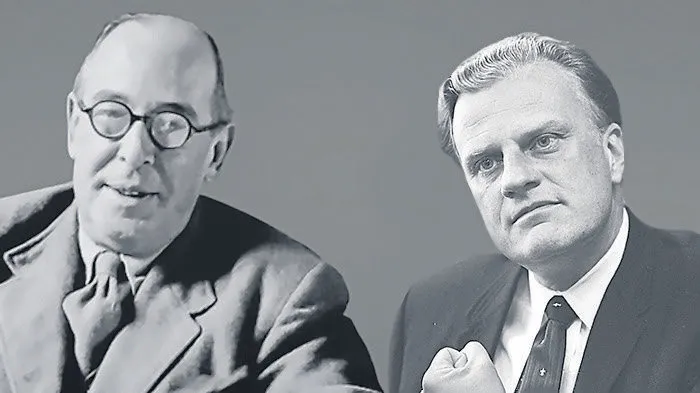
One conversation where I would love to have been a fly on wall took place in Cambridge in 1955, when Billy Graham met C. S. Lewis. John Stott was there too. There is a brief account of it in Roger Steer’s excellent Inside Story: The Life of John Stott (IVP).

Billy facing criticism

During the famous 1954 Harringay missions, Billy Graham had the support of John Stott. The responses to the gospel appeal were overwhelming. While mainline churches were suffering seemingly terminal decline, 38,000 people made some kind of response during this series of outreach meetings. Asked the secret of Billy Graham’s appeal John Stott said: ‘Billy was the first transparently sincere preacher these people have ever heard.’ It was not primarily about technique or content but about authenticity.

In 1952 Stott had led a Christian Union mission at Cambridge University and in 1955 he returned, this time as assistant to Billy Graham. The invitation had provoked resistance, particularly from the liberal elite.

Letters to The Times had questioned the appropriateness of Billy Graham addressing university students. Derided as a fundamentalist, ignorant of scholarship, many Anglican leaders were embarrassed by Graham’s clear commitment to the simple gospel. Stott entered that debate, writing a reasoned defence of Graham’s ministry. However, the criticisms probably did sting Billy Graham, who confessed of the Cambridge University mission: ‘I have never felt more inadequate and totally unprepared.’

Lunch together

However, Stott had another ally in support of Graham. He arranged lunch for them with C. S. Lewis at his Cambridge college. I wish I knew what was said. I don’t; however, it was clear that the encounter demonstrated a meeting of minds.

Billy Graham later recalled: ‘Among the professors I met with privately that day was C. S. Lewis. A decade before, he had captured the imagination of many in England and the United States. I was afraid I would be intimidated by him because of his brilliance, but he immediately put me at ease. I found him to be not only intelligent and witty but also gentle and gracious; he seemed genuinely interested in our meetings.’

Modest and sensible

We also know what C. S. Lewis thought of that day. In an interview, shortly before his death in 1963, he said ‘I had the pleasure of meeting Billy Graham once. We had dinner together during his visit to Cambridge University in 1955, while he was conducting a mission to students. I thought he was a very modest and a very sensible man, and I liked him very much indeed.’ Lewis went on to point out that he agreed with Billy Graham’s emphasis on calling people to a decision.

C. S. Lewis, Billy Graham and John Stott were three very different giants of the faith. They had different gifts and different callings. But they were captured by the same vision, servants of the same Saviour. As we have seen, Stott described Graham as ‘transparently sincere’; the same could be said of Stott himself and of C. S. Lewis too. They lived what they believed. And what they lived was deeply attractive. ‘You know,’ Lewis said to Graham at the end of their lunch together, ‘you have many critics, but I have never met one of your critics who knows you personally.’ Apologetics is a powerful component of evangelism, but so too is a transparently sincere faith. Billy Graham exercised that.

Share
< Previous article| Features| Next article >
Read more articles by Chris Sinkinson >>
Features
In the footsteps of David

In the footsteps of David

Generally, the further back in time the harder it is to prove that something has happened. We regularly report in …

Features
The Bible and Iran

The Bible and Iran

As bombs fall and a dangerous regime plunges the region into chaos, it might seem trivial to write an article …

About en

Our vision, values and history

Read more

Need to advertise?

We can help you reach Christians across the country

Find out more