The English Reformer Hugh Latimer (c.1495–1555), whose early life we looked at last month, preached hundreds of sermons, but there are only 41 extant.
Of these, 28 were preached at Grimsthorpe, Lincolnshire, at the estate of Katherine Willoughby (1519–1580), the Dowager Duchess of Suffolk, or to country congregations near to her castle.
The Grimsthorpe sermons
The Grimsthorpe sermons, along with the 13 others extant, were actually copied down as Latimer preached. This proved quite difficult, as the copyists struggled to keep up with what has been called ‘the torrent of the preacher’s eloquence’ and fluency. The Grimsthorpe sermons especially reveal a preacher who was able to adapt himself to his audience: he explicates a biblical text in its context, explains points of doctrine, empha-sizes moral lessons, warns against the errors of the Roman Catholic Church, and all the while the sermons are suffused with passion and earnestness
Here, for example, is Latimer speaking about the necessity of knowing Christ for salvation, in a sermon he preached on 27 December, 1552, the day assigned to St John the Apostle in the liturgical calendar of the Western Church: ‘… by [Christ’s] passion, which he hath suffered, he merited that as many as believe in him shall be as well justified by him, as though they themselves had never done any sin, and as though they themselves had fulfilled the law to the uttermost. For we, without him, are under the curse of the law; … but Christ with his death hath delivered us from the curse of the law. He hath set us at liberty, and promiseth that when we believe in him, we shall not perish; the law shall not condemn us. Therefore let us study to believe in Christ. Let us put all our hope, trust, and confidence only in him; … God hath given him unto us to be our deliverer, and to give us everlasting life. O what a joyful thing was this!’
During one of the Grimsthorpe sermons that Latimer preached on the petition ‘Thy kingdom come’ from the Lord’s Prayer (Matthew 6.10), he made a statement that, from the perspective of later events, can be regarded as almost predictive. ‘Happy is he’, he said, ‘to whom it is given to suffer for God’s holy Word’s sake.’
Lighting a candle
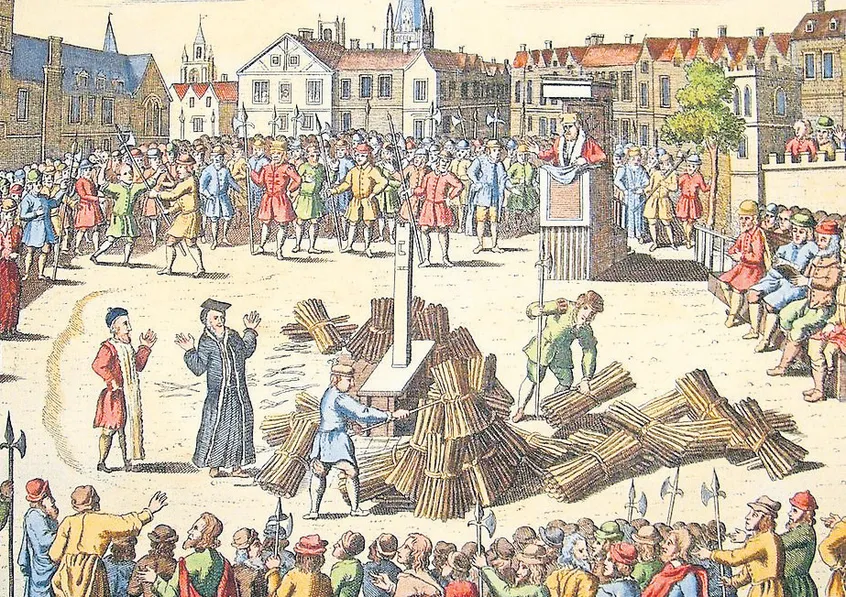
Three years later, during the reign of Mary I (1516–1558) – who was determined to destroy the evangelical faith in England and return the nation to the bosom of the Roman Church – Latimer and his fellow bishop Nicholas Ridley (c.1500–1555) were indeed called to suffer and die for the sake of their commitment to God’s Word and its authority over all of life. Latimer had been committed to the Tower of London in September 1553 and then, in April 1554, he was taken with Ridley to the Bocardo prison in Oxford where they underwent examination of their theological beliefs.
Both were found guilty of heresy and condemned to death. While in the Bocardo, Latimer wrote the following in a lengthy letter dated 15 May, 1555:
Because you be God’s sheep, prepare yourselves to the slaughter, always knowing, that in the sight of God our death is precious. …
Die once we must; how and where, we know not. Happy are they whom God giveth to pay nature’s debt (I mean to die) for his sake. Here is not our home; let us therefore accordingly… [have] always before our eyes that heavenly Jerusalem, and the way thereto in persecution.
On 16 October, 1555, Latimer and Ridley were taken out of Oxford through the Bocardo Gate where they were tied to a stake in what is now Broad Street. Wood was piled around the two bishops, but the wood piled around Ridley was freshly cut and thus only smouldered. Ridley was in conscious agony till the very end and at one point was heard to pray: ‘I cannot burn! Lord have mercy upon me!’ Latimer, though, died fairly swiftly, but before he did so he uttered the following words in response to this cry by Ridley. These words, recorded by the English marty-rologist John Foxe (1516/17–1587), form a fitting conclusion to any study of Latimer as a preacher, for in a sense they have a sermon-ic quality: ‘Be of good comfort Master Ridley, and play the man! We shall this day light such a candle by God’s grace in England, as I trust shall never be put out.’