How does the church operate in an increasingly hostile culture which no longer assumes Christianity is essentially good?
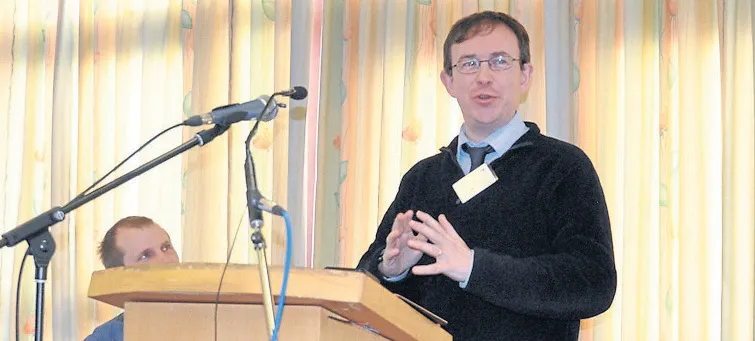
That was the topic when around 75 people, mostly church leaders and theological students from across the whole of the UK and from widely different denominational groups came together in March for the biennial Affinity Theological Study Conference.
The unique format of this conference is that papers are sent in advance and then presented in summary form so time at the event can be mainly used discussing and debating the ideas.
Special yet common
David Green (London Seminary) spoke on God’s people in the Old Testament as light to the gentiles. Our role is to reject the false gods and alternative realities of the unbelieving world, but not to reject the people of the world outside the church, or their observations about life, rather to see ourselves as sharing a common humanity and called by God to be the means through which he works out his purposes for the world in Christ. We critique human society whilst also being the instrument by which God saves people through our proclamation of the gospel.
Creation and restoration
Chris Bennett (Wilton Community Church) spoke on the people of God in the New Testament. God’s mission is holistic. Conservative Protestants tend to place undue weight on the church as organisation rather than church as organism, where contextuali-sation and perpetual change are essential and suffering (including the pain of risk-taking), is a mark of the true church. The church and its mission must be seen in connection with the doctrine of creation and its restoration and with the fact that grace does not replace nature, but renews it. Preaching is very important, but it is not everything and it is not even nearly everything.
Learning from history
Paul Helm (former Professor at King’s College, London) traced Augustine’s changing view on Christendom, particularly before and after the sack of Rome by the Goths in 401 AD. Augustine contrasted Rome with the city of God – the church. The church has God’s Word and Spirit, but little of outward glory or political clout. This is normal. Is this not part of the weakness made strength that is characteristic of the New Testament?
Lee Gatiss (Church Society) gave a historical sweep from the Reformation to today tracing various periods when the church was on the ascendancy in the culture as well as times of persecution. As we unwind all the tangled threads of cultural, social, and economic context, the story of the great political and theological battles of the past enables us to glimpse just a little that we are not the first or only generation to face such pressing anxieties and questions.
John Stevens (FIEC) called us to recognise that the contemporary political context in the UK is a direct result of the collapse of Christian belief, rather than its cause. Far too many Christians hanker for a lost, and largely mythical, past. With this sense of realism we need to preach the unchanging gospel in appropriately contextualised ways, and to seek and save the lost just as Jesus did. This will be hard work, and we need to know both that we will be persecuted and that we will receive the eternal reward of the ‘crown of righteousness’ if we persevere to the end.
People of hope
David McKay (Shaftesbury Square Church, Belfast) gave a stirring conclusion to the conference, encouraging us to know who we are as the redeemed people of God, preaching God’s Word with confidence. We are people of hope, grounded in the finished work of a great Saviour. Far from weakening our commitment to serving God, this simple but firm hope in the truth provides a tremendous stimulus to godly living and service.
Loving country without losing the gospel
Christmas decorations are now up everywhere. For some people, this is a welcome relief from the ongoing proliferation of the …