Open the king’s eyes

Michael Haykin  |  Features  |  history
Date posted:  1 May 2017
Share Add       
Open the king’s eyes

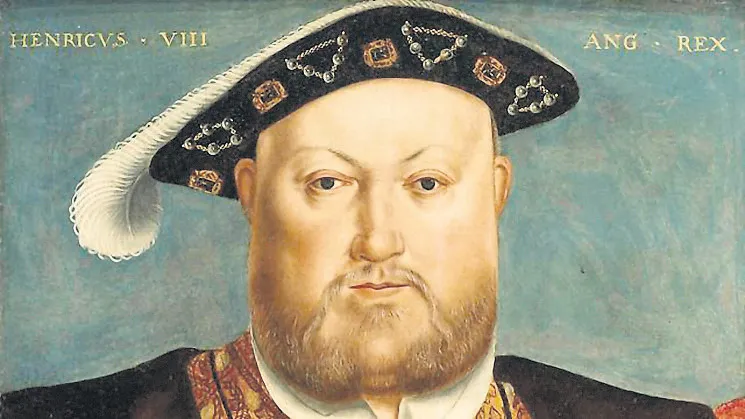
Henry VIII | photo: BBC

There is a portrait of William Tyndale that hangs in the dining-hall of Hertford College, Oxford.

His right hand in the painting is pointing to what appears to be a Bible, under which there is a Latin couplet, of which the translation runs thus:

To scatter Roman darkness by this light
The loss of land and life I’ll reckon slight.

This painting accurately captures Tyndale’s view of God’s Word – a sure and certain light in the midst of the darkness of this world – and if need be Tyndale was willing to give his life that his countrymen might have this light.

Translating the Old Testament

After completing the translation of the New Testament, which we looked at last month, Tyndale turned his attention to the Old. His translation of Genesis, which appeared in 1530, was the first English translation ever made from a Hebrew text. Only a tiny handful of Oxford and Cambridge scholars, if any at all, knew this language. In fact, most of the English population would have been astonished to discover that Hebrew had anything to do with the Bible. For them, all of their religion was wrapped up in Latin. Translations of a number of other books of the Old Testament followed: the rest of the Pentateuch in 1530 and Jonah in 1531.

Where Tyndale learned Hebrew we have no idea. It is quite unlikely he learned it in England, since so little Hebrew was known there in the 1520s. Hebrew studies only began to take root in England during the reigns of Elizabeth I and James I. He had to have learned it, therefore, on the Continent, probably in Germany. David Daniell suggests that Tyndale may have studied Hebrew at Wittenberg when he was there in the mid-1520s.

As with the Greek New Testament, Tyndale displays a wonderful facility for rendering the Hebrew Scriptures – a linguistic world utterly unlike any other in Europe at that time – into English. And coinages that he made, like ‘Jehovah’, ‘Passover’, ‘scapegoat’, ‘shewbread’, and ‘mercy seat’ have become a part of standard English.

‘Permit me the Hebrew Bible’

By the early 1530s Tyndale was living in Antwerp, hard at work on translating Joshua to 2 Chronicles, as well as making some minor revisions to his third edition of his New Testament (1534).

The translation had not yet progressed beyond the manuscript stage when he was arrested on May 21, 1535. Tyndale was betrayed into the hands of Roman Catholic authorities by a certain Henry Phillips, a perfidious individual who was probably acting under orders from John Stokesley, the Bishop of London.

He was imprisoned in the infamous prison of Vilvoorde, six miles north of Brussels. There he was put on trial for heresy – specifically for being a Lutheran – found guilty and condemned to be burned to death.

Two word pictures

Two word-pictures from the last year of his life reveal the character of the man.

The first comes from a letter that he wrote in the Vilvorde prison in the autumn of 1535. It was found during the 19th century and is the only surviving example of his handwriting. Writing to the governor of the prison, Tyndale requested a lamp in the evening: it is indeed wearisome sitting alone in the dark. But most of all I beg and beseech your clemency to… permit me to have the Hebrew Bible, Hebrew grammar and Hebrew diction- ary, that I may pass the time in that study.

Right to the very end, Tyndale was intent on the study and translation of God’s Word – that precious book that Tyndale knew God the Holy Spirit would use to shed the light of God’s salvation throughout benighted Europe.

The other word-picture comes from the day of his death, traditionally 6 October, 1536. The executioner, in an act of mercy to Tyndale, strangled him before he lit the wood piled around him. According to the martyrologist John Foxe, the last words that Tyndale was heard to utter were: ‘Lord! Open the King of England’s eyes.’

Within a year

Up until this point the king, Henry VIII, had been firmly opposed to the free circulation of Tyndale’s translation, despite his break with Rome over his desire to get a divorce from his first wife Katherine of Aragon. Yet, within a year of Tyndale’s death his New Testament was being openly published in England, though not under his name. That Tyndale was not recognised as the translator would not have bothered him at all.

Share
< Previous article| Features| Next article >
Read more articles by Michael Haykin >>
Features
The martyrdom of Cyprian

The martyrdom of Cyprian

The church in North Africa was a leading centre of Christianity throughout the Ancient World. It was only with the …

Features
Martyrdom and schism

Martyrdom and schism

Tertullian (c.160/170–c.220) had a genuine knack for pithy sayings that stick in the mind. For instance, there is his well-known …

Looking for a job?

Browse all our current job adverts

Search

Need to advertise?

We can help you reach Christians across the country

Find out more