‘Very sweet honey’

Michael Haykin  |  Features  |  history
Date posted:  1 Oct 2016
Share Add       
‘Very sweet honey’

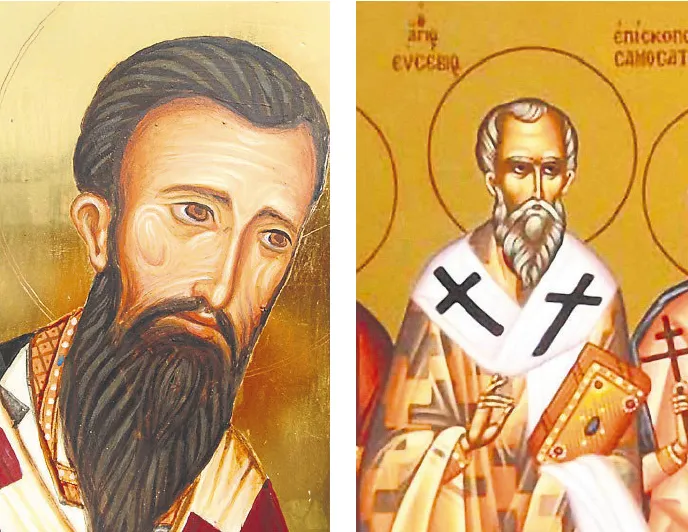
Basil of Caesarea (left) and Eusebius of Samosata

The Greek Christian author Basil of Caesarea (c.330 – 379) was an extremely important theologian.

His defence of the deity of the Holy Spirit in the final stages of the Arian controversy played a critical role in the formulation of the orthodox Christian teaching about the Trinity. Basil has much to teach us, though, about other areas of the Christian life. Take, for instance, the vital area of Christian friendship.

Eusebius of Samosata

One of Basil’s closest friends was Eusebius, Bishop of Samosata (died 380), a city on the Euphrates River, some 300 miles distant from Caesarea in Cappadocia. Samosata has been described by historian Lewis Ayres as a ‘strategically important city’, for it was ‘close to the borders of the [Roman] Empire.’ Samosata contained Greek speakers like Eusebius, but also many Syriac- and Armenian-speaking Christians. Most of what we definitely know about Eusebius is from the letters of Basil. There is little doubt that the two men deeply enjoyed each other’s presence and Basil delighted in having such a mentor.

Basil speaks of Eusebius’s ‘venerable age’ in his Letter 98, which would probably place his birth between 303 and 313 and this would mean he was probably a generation older than Basil. Their friendship thus cut across genera-tional barriers. When he became the Bishop of Samosata is also unclear. He was definitely in that position by 361.

Thirteen years later, in 374, by order of the Emperor Valens, who was an Arian (denying the full deity of the Lord Jesus), Eusebius was banished to Thrace in northern Greece. His congregation was devastated by the loss of the bishop. Some of them pursued Eusebius after he had been banished and, with tears, pleaded with him to stay with them and brave the wrath of the emperor. But Eusebius felt he had no choice but to obey the imperial order.

In 378, however, the persecuting policy of the Emperor Valens was brought to a close by his death at the Battle of Adrianople in the Balkans. Valens’s successor, the Emperor Gratian, recalled a number of banished bishops, including Eusebius. But Eusebius was to enjoy the return to his congregation in Samosata for only two years. In 380 he travelled to Dolikha in northern Syria to participate in the ordination of a bishop for that city. An Arian woman took the opportunity to throw a roof tile at his head that proved to be fatal. It is noteworthy that, as he lay dying, Eusebius urged his followers to forgive the woman and not to harm her in any way.

His friendship with Basil

There are some 15 extant letters of Basil to Eusebius that provide fascinating windows on their friendship. In the autumn of 368, Basil wrote to Eusebius informing him of his desire to visit him in Samosata to enjoy Eusebius’s ‘treasured wisdom’ (Letter 27). A year later, Basil commended Eusebius for his zeal for the truth (Letter 34) and in 371 Basil told his friend that he hoped to see him the following Spring so as ‘to be reinvigorated by your sound teaching’ (Letter 48). Again, three years later, Basil called Eusebius ‘the noble guardian of the faith, the faithful protector of the churches’ (Letter 136). Friends are not afraid to point out areas of strength.

In a number of his letters to Eusebius, Basil also thanks his friend for his prayers: for church matters in which Basil is involved (Letter 30) and for Basil’s health (Letters 100, 162). In August of 373, Basil, racked with pain, was deeply thankful that Eusebius was remembering him in prayer. He told him that his letters were like ‘a beacon fire shining from afar upon the deep… naturally possessing sweetness and great consolation’ (Letter 100).

Basil used the imagery of sweetness again that year in Letter 138, when he told his friend that spending time with him the previous year, 372, had been like ‘a taste of very sweet honey.’ And again he urged the Bishop of Samosata to pray for him. In one of Basil’s final letters to Eusebius that we possess, Letter 241, written in 376 – Basil died on 1 January, 379 – Basil again mentions Eusebius’s praying. On this occasion, he likened his friend’s prayers to those of Moses – high praise indeed.

Basil would have found it very odd that Christians can claim others as their friends and then not pray for them. If we say that we love one another and do not pray for each other, we lie and do not the truth.

Share
< Previous article| Features| Next article >
Read more articles by Michael Haykin >>
Features
The martyrdom of Cyprian

The martyrdom of Cyprian

The church in North Africa was a leading centre of Christianity throughout the Ancient World. It was only with the …

Features
Martyrdom and schism

Martyrdom and schism

Tertullian (c.160/170–c.220) had a genuine knack for pithy sayings that stick in the mind. For instance, there is his well-known …

Give a subscription

Our monthly newspaper is the perfect gift for those who love to think deeply

Give here

New here?

Register and get three free articles each month!

Register