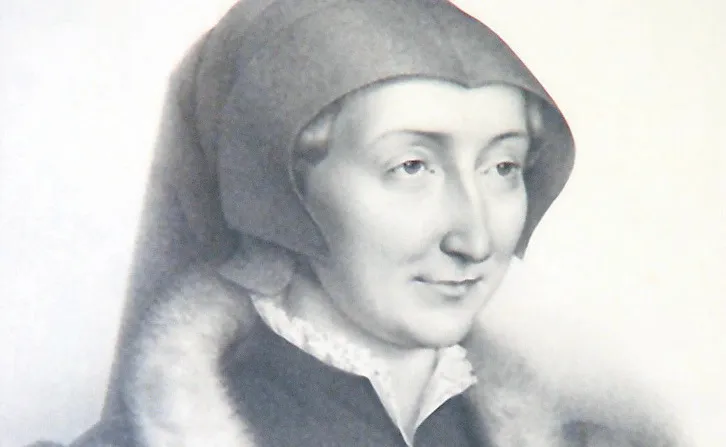
We know little about John Calvin’s marriage to Idelette van Buren (aka Idelette de Bure).
That is certainly true when compared to the marriages of other Reformers. Martin Luther’s famous marriage to Katharina von Bora, for example, became something of a public exemplar for Protestants.
Not so Calvin’s marriage, which was very much in line with Calvin’s habitual reticence to go public about his personal affairs. Yet, in the year following Idelette’s death in 1549, he stated in his little tract Concerning Scandals (1550) that Idelette was ‘a rare woman’.
Marriage to Idelette
Idelette van Buren’s roots were originally in the Netherlands and she may well have come from the town of Buren in the province of Gelderland. Be this as it may, her first husband Jean Stordeur was a Walloon from Liège, today in Belgium. For a time Jean and his wife Idelette were convinced Anabaptists. And it was as a prominent Anabaptist that Jean had first met Calvin in Geneva in March 1537 when Jean came to the city for a discussion between the Anabaptists and the Reformed pastors. Two years later, now in Strasbourg, Calvin had succeeded in convincing Jean and Idelette to embrace Reformed theology, and they became members of the French congregation that Calvin was pastoring in Strasbourg.
It was not long after this that Jean died of the plague in the spring of 1540. Calvin obviously got to know Idelette initially through the discussions he had with her and her husband about the Reformed faith. Then, when Jean was dying, Calvin would have seen more of Idelette when he made pastoral visits to their home. What he saw of her made such a deep impression on him that by 17 August, 1540, Calvin had married her. Although Calvin often emphasized that external beauty was not to be a key determinant in marriage, Idelette was, according to Farel, very pretty.
Intimate allies
Now, we get a fabulous insight into Idelette’s character in a letter that Calvin wrote after her death on 29 March, 1549. It was addressed to his close friend Pierre Viret and written on 7 April, 1549. In it Calvin stated: ‘Although the death of my wife has been exceedingly painful to me, yet I subdue my grief as well as I can. …you know well enough how tender, or rather soft, my mind is. Had not a powerful self-control, therefore, been vouchsafed to me, I could not have borne up so long. And truly mine is no common source of grief. I have been bereaved of the best possible companion of my life, of one, who, had it been so ordered, would not only have been the willing sharer of my indigence, but even of my death. During her life she was my faithful co-labourer in my ministry.’
Here, in the space of a few lines from his sorrowing heart, Calvin sums up the Reformed understanding of marriage: it is a union of intimate allies. Idelette had been the ‘best possible companion’ of his life, one who had been a ‘faithful co-labourer’ in his ministry.
Marriage defined by Genesis 2
Behind Calvin’s understanding of marriage lies Genesis 2.18–24, where we are told that Adam’s being alone is not ‘good’, which is striking in view of the fact that everything else that God had made to that point is said to have been good. So, we read in this passage, that God made Adam a ‘helper’, a word, according to Calvin’s commentary on this text, which goes to the heart of his understanding of marriage.
The French Reformer comments on this passage in Genesis: ‘Now, since God assigns the woman as a help to the man, he … pronounces that marriage will really prove to men the best support of life. … The vulgar proverb, indeed, is, that she is a necessary evil; but the voice of God is rather to be heard, which declares that woman is given as a companion and an associate to the man, to assist him to live well.’
But the fallenness of humanity – which, in Calvin’s day, had issued in the unbiblical perspectives on marriage, celibacy and sexuality promoted by Roman Catholic theologians – has deeply disfigured God’s intentions for the holy estate of marriage. As Calvin went on to delineate: ‘if the integrity of man had remained to this day such as it was from the beginning, … the sweetest harmony would reign in marriage.’
And it was this conviction about marriage, rooted as it was in solid reflection on Scripture, that led Calvin to make such wide-ranging statements about marriage as that it is ‘the sacred bond,’ ‘a holy fellowship’, ‘a divine partnership’, ‘a loving association’, ‘the best support of life’ and ‘the holiest kind of company in all the world’.