
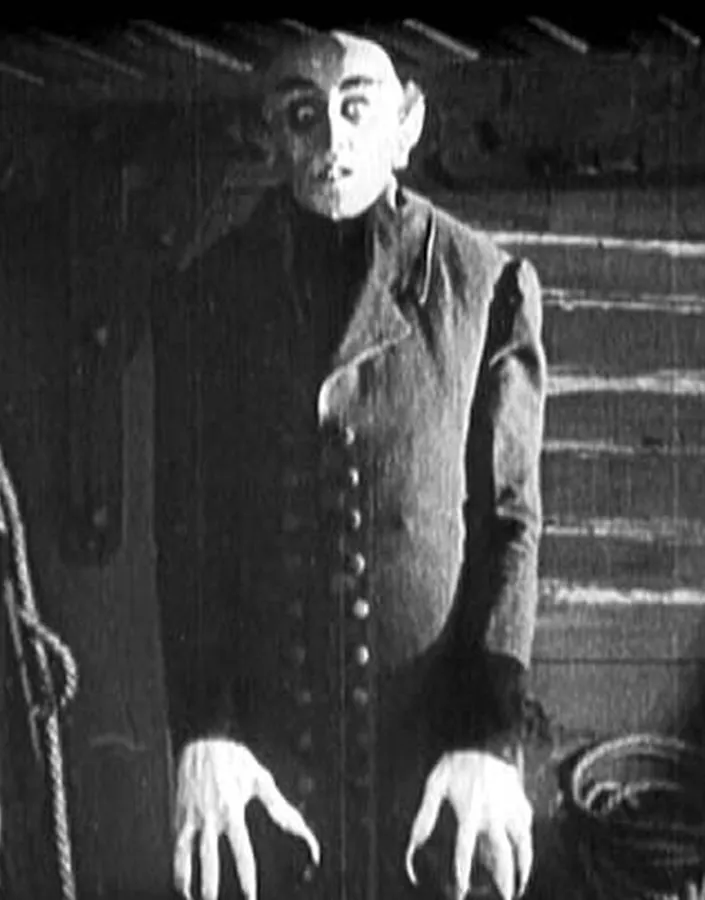
One should never watch anything that wounds one’s conscience; Romans 14:23 tells us there are terrible consequences of acting against our conscience.
I don’t often, therefore, speak about my fascination with the horror genre in cinema. And yet, the popularity of horror films is worth pondering. Rather than engage at any length with the film which prompted these reflections — Robert Eggers’s 2024 remake, Nosferatu — what might its success teach us?
We need ways to describe the darkness
First, the persistent appeal of horror shows we need ways to describe the darkness. Different historical periods — with their wider anxieties, worries and fears — have brought forth different sub-genres within horror, and different antagonists. As much as these stories are the fruit of real creativity, they are also often responsive to very real threats.
Horror, then, is at its most powerful not when it speculates on evils we never encounter, but when it offers imaginative ways to describe the darkness of the world we actually inhabit. The 2024 version of Nosferatu, directed and written by Robert Eggers, features a devastating outbreak of bubonic plague, with the streets filled with pestilential rats, and hospitals overrun — close to the bone for an audience who have lived through a pandemic.
We’re ‘buffered’ enough to feel safe watching it
Second, however, our fascination with horror shows how safe we feel; it testifies to our ‘buffered’ identity, to use the language of the philosopher Charles Taylor. In A Secular Age (2007), Taylor argues that premodern identities in an enchanted world were ‘porous’, open to supernatural forces which can ‘get to’ us. In a secular age, the disenchantment of the world goes hand-in-hand with a ‘buffered’ self, in which nothing ‘gets to’ us as it did — not even the horrors we once feared.
Taylor writes, ‘It is a feature of the buffered identity that we often experience such a frisson where our ancestors were genuinely terrified, as in horror movies.’ (p.337) The fact that we can derive entertainment from these stories shows the extent to which we no longer feel vulnerable to the dark spiritual forces they portray. We feel safe to watch horror — although, of course, as Ephesians 6:12 points out, we are just as vulnerable as our premodern forebears were.
We have a twisted (but real) longing for the light
One of the protagonists of Nosferatu asks, ‘Does evil come from within us, or from beyond?’ For those who think that reality is nothing more than time, matter and chance, and that humanity is no more than the byproduct of an unguided process of evolution, it is not clear that this is a meaningful question. There is no ‘beyond’, and neither — once God has been cut out of the picture — is there ‘evil’ in any significant sense. So it is telling that horror is the genre in which this significant question can be asked, and taken seriously.
And we do yearn to ask questions like these, and have them taken seriously. Why? Because we have a twisted (but real) longing for the light. As Frederick Buechner put it in Telling the Truth (1977), ‘If the dark and monstrous side of fairy tales can be proved to exist, who can be sure that the blessed side doesn’t exist, too?’ For Buechner, ‘the whole obsession of our time with the monstrous in general’ (although, as the box office shows, this obsession continues half a century later) is ‘at its heart only the shadow side of our longing for the beautific.’ (p. 86)
‘Beautific’ is a word unknown to the Oxford Dictionary. Knowing Buechner, however, it is unlikely to be a simple misspelling. It brings together the ideas of both blessing and beauty: it expresses what we were made for, and therefore long for, and can only receive from God. Our fascination with darkness, and stories which explore it, can be an unlikely witness to the One who is light, and in whom there is no darkness at all.


Farage, Lowe, Polanski... pray for them
Some swords are double-edged; they can cut both ways, not just at those against whom they are wielded, but also …